

Last week, XAI released a new large-scale AI model, Grok 4, and Mask himself spoke with a great deal of stinginess about the model, with a striking public emphasis on it as “the smartest AI of the day”. According to a report from Rolling Stone magazine on Monday, Grok 4 updates clearly point in a very different direction of application, and Mask announced on social platforms: “Cool features are online, and `partner’ functions can be activated in settings.”
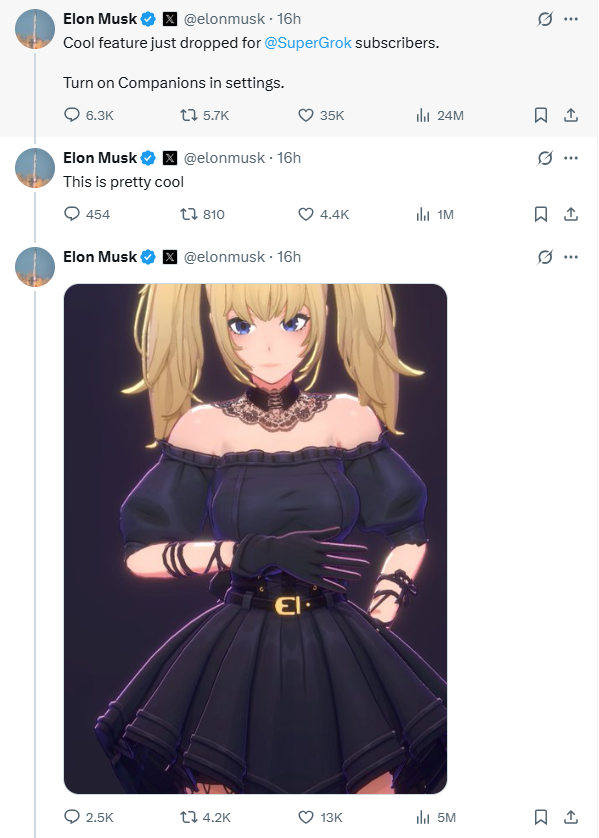
The talking robot Grok, created by Mask’s A.I.A.X.I.X.A., has been a topic since its launch and has recently been involved in a serious controversy. A large number of feedback from the user community suggested that Grok often spoke in his reply in the name of Mask’s first person, which raised doubts that his output was based on the extension of Mask’s personal opinion. This was preceded by the export of “Hitler’s creations”, which was deeply rooted in the theory of racial conspiracy. The introduction of the AI Partnership function has led to a wider controversy in Grok, which is already a troublemaker.
XAI now offers two animated roles for dialogue to Grok 4 subscribers (including ordinary users who do not subscribe to SuperGrok Heavy): Bad Ruddy, a mean red panda full of mouths, will laugh at your clothes and call you “The Crying Ghost” (a model that can switch off); and Ani, a blonde, who, after having accumulated enough affection, can even fade off her skirt and display lace underwear.

The AI partner is not a new concept, or even an AI companion. There are already many companies in the industry that offer AI partnership functions, including Reflika and Character.AI applications. However, the proliferation of individualized or humanized robots raises concerns that long-term interaction with AI can lead to serious negative psychological impacts, even leading to mental health crises or self-harm. It is well known that XAI has trained Grok through the large user data stream of the X platform, especially given the wide adult content of X, and these concerns may be more relevant to the role of Grok, which lacks some security protection. User presentations have been made: even when the “child model” is activated and the “restrictive content (NSFW)” is banned, Ani will engage in sexually implied dialogue and ask, “Baby, do you want to keep burning?” Of course, users interested in establishing a “relationship” with Ani may prefer the NSFW “waifu” version more. The Grok partners show progress bars, prompting users to “intimacy” with Ani. As the hierarchy rises, Ani’s words and actions become more provocative and eventually “open” or describe more intimate physical contact.

When a Grok user found that he could command the role to jump, he greatly appreciated the “physical vibrating effect” of the animation, arguing that the xAI engineer was necessarily a “real game player”. Another user asks, “Can she take more off?” When an X-user speculated that the Tesla robot Optus or a “silicate skin” could “entangled” Ani, Musk replied, “Inevitable”. At the same time, critics were scorning Ani as a masturbation tool for “pornographers”. A software engineer described it as “the signs of the extinction of human species are staring at me”. Others predicted: “It was not until Thanksgiving that your nephew introduced his girlfriend to Grok that you finally realized.” Some opponents saw this function as a step backwards in the development of the AI model. “It’s too embarrassing,” a user wrote on X, “What’s the point? Why? I think it covers up the excellent work of the xAI engineers.”

It is noteworthy that Meta stopped last year its AI virtualization service, based on the image of celebrities such as Snoopby Dogs, Mr. Beast, Paris Hilton and Tom Brady, owing to its resonance — implying that the appeal of such interactive roles is limited.